
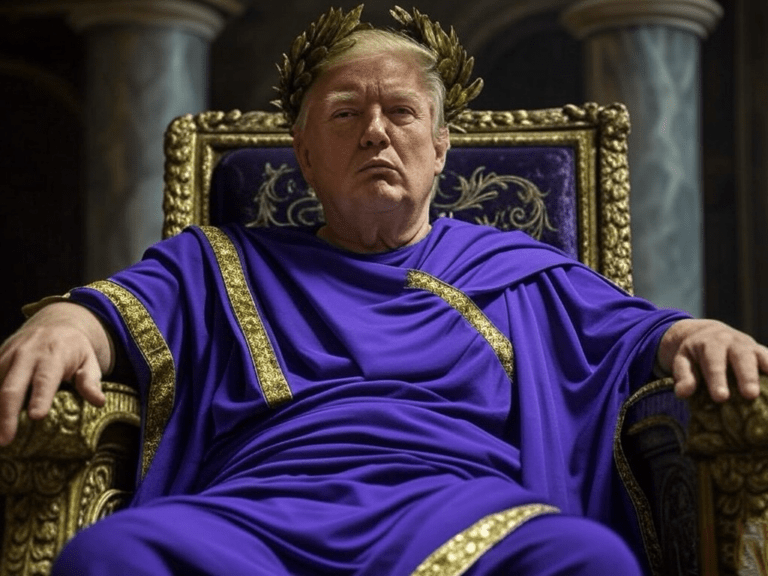
Hail Caesar! The Art of the Roman Deal
What happens when Donald Trump lands in ancient Rome? The Senate, the Colosseum, and even Jupiter discover that no empire is ready for a man who wants to rename everything.
🏛️ Hail Caesar! The Art of the Roman Deal
A satirical short story — Ancient Rome meets modern political absurdity.
Chapter I: A Very Stable Empire
In the year 47 BC, the Roman Republic was in crisis.
The Senate was divided. The economy was struggling. The barbarians were restless. And Julius Caesar, having conquered half the known world, had developed the dangerous habit of believing his own speeches.
Then, one morning, a mysterious golden portal opened above the Forum.
Out stepped Donald Trump.
He wore a red toga, golden sandals, and an expression suggesting that the entire Roman Empire had personally disappointed him.
A Roman guard approached cautiously.
“Halt! Who are you?”
Trump looked him up and down.
“Who am I? I'm Donald Trump. People tell me I'm the greatest leader they've ever seen. Some say greater than Alexander. Very smart people. Historians, actually.”
The guard blinked.
“Are you a god?”
Trump paused.
“I'm not saying that. But the ratings would suggest it.”
And just like that, Rome had a new problem.
It had already survived civil wars, plagues, and ambitious generals.
Now it had to survive a press conference.
Chapter II: Make Rome Great Again

Trump was invited to address the Senate.
He climbed onto the marble platform and gazed at the senators, who wore their finest togas and their most suspicious expressions.
“Citizens of Rome!” he announced. “This empire is a disaster. Total disaster. The roads? Terrible. The aqueducts? Overrated. The Colosseum? Frankly, too many seats. Nobody knows how to build anymore.”
Marcus Cicero raised an eyebrow.
“The aqueducts deliver fresh water to a million citizens.”
“Fake water!” Trump declared. “I've seen better water. The best water. At my estate.”
He unfurled a scroll.
“Today, I announce my plan: Make Rome Great Again.”
The Senate erupted in whispers.
“What does that mean?” asked Cicero.
Trump smiled.
“First, we're building a wall.”
“Against whom?” asked a senator.
“Everyone. Nobody knows who's coming through those gates. Gauls. Greeks. People from that place with the excellent olives. Very suspicious olives.”
“But the wall would cost more than the annual treasury,” Cicero protested.
“Then we'll make the barbarians pay for it.”
Silence.
A senator leaned toward another and whispered, “Can they even do that?”
His colleague shrugged. “I don't know. But he says everything as if it's already law.”
Chapter III: The Colosseum Ratings Crisis
Trump soon discovered Rome's greatest entertainment attraction: gladiatorial combat.
He summoned the arena manager.
“What's your attendance?”
“Fifty thousand spectators, Caesar.”
“Fifty thousand? Pathetic. My inauguration—”
“Your what?”
“Never mind. We're going to have the biggest games in history. The greatest games. Lions, gladiators, chariots. Perhaps a lion riding a chariot. People love that.”
The manager bowed nervously.
“And the gladiators?”
“Make them fight harder. Nobody wants to see a man surrender after three minutes. It's terrible for television.”
A week later, the games began.
Trump sat in the imperial box wearing a purple toga embroidered with tiny golden eagles. Beside him sat Julius Caesar, who had made the mistake of attending out of curiosity.
A gladiator entered the arena.
Trump grabbed the announcer's scroll.
“Ladies and gentlemen, this gladiator is a loser. Total loser. He has lost seven fights, maybe eight. Nobody knows. But his opponent? Incredible warrior. Strong hands. Beautiful sword. The best sword I've ever seen.”
The crowd roared.
Then the underdog gladiator defeated his opponent in twelve seconds.
Trump stared in disbelief.
“Rigged.”
Caesar turned slowly.
“By whom?”
“The referees. The Senate. Probably the Gauls.”
A senator whispered, “The Gauls weren't involved.”
Trump pointed at him.
“That's exactly what someone involved with the Gauls would say.”
Within minutes, half the arena was chanting, “RIGGED! RIGGED!”
The other half was selling merchandise.
Rome had never seen such a profitable disaster.
Chapter IV: The Senate Gets Fired
Trump's next reform was to replace the Roman Senate with a television-style elimination contest called The Apprentice: Republic Edition.
Every senator had to defend his record before a panel consisting of Trump, two former gladiators, and a man who claimed to be an expert in chariot finance.
Cicero was first.
“Your policies have weakened the Republic,” he began.
Trump interrupted him.
“Wrong. Terrible opening. No charisma. You're fired.”
“But I haven't finished my argument!”
“Exactly. You talk too much.”
Next came Cato the Younger.
“Power must be restrained by law.”
Trump leaned toward the audience.
“Very negative man. Sad. Doesn't smile. Probably never had a good banquet.”
“Rome is not your personal estate!” Cato shouted.
Trump stood up.
“And that's why you're fired twice.”
By sunset, half the Senate had been dismissed.
By midnight, Trump had appointed himself Minister of Everything.
His official title became:
Donald I, First of His Name, Protector of the Forum, Master of the Legions, and Owner of the Greatest Hair in the Mediterranean.
The Senate's only surviving member was a confused accountant who had been hiding beneath a table.
Trump appointed him Minister of Finance.
“Congratulations,” he said. “You're in charge of the money.”
The accountant swallowed.
“How much money do we have?”
Trump smiled.
“An incredible amount.”
“How much, exactly?”
“That's classified.”
Chapter V: Beware the Ides of March

Eventually, even the Roman gods began to worry.
Jupiter summoned Mercury.
“Is this Trump fellow a threat to the empire?”
Mercury consulted his tablet.
“He has doubled the price of statues bearing his likeness, renamed the Forum after himself, and ordered every historian to describe him as 'the most victorious Roman who ever lived.'”
“And the people?”
“Half adore him. Half despise him. The rest are selling commemorative coins.”
Jupiter rubbed his temples.
“Can we send him back through the portal?”
“Possibly. But he has renamed it the Trump Gateway to Eternity and is charging admission.”
Meanwhile, Caesar had grown increasingly concerned.
“Donald,” he said one evening, “you have seized control of the Senate, insulted the gods, and accused the aqueducts of being a conspiracy. Perhaps it is time you returned to your own era.”
Trump stared at him.
“Julius, I like you. You're a winner. But frankly, your brand is fading. You conquered Gaul, sure. But have you ever conquered a news cycle?”
Caesar said nothing.
Trump leaned closer.
“Also, your hair. We need to discuss your hair.”
That was the final insult.
The next morning, Caesar called a secret meeting with Brutus and the other conspirators.
Brutus looked troubled.
“Are we truly considering assassination?”
Caesar shook his head.
“No. I've been thinking. We'll simply ask him to attend a very important meeting in the Senate.”
“And then?”
“Then we'll let him speak for six hours.”
Brutus gasped.
“Cruel.”
“Necessary.”
Chapter VI: The Greatest Exit in History
On the Ides of March, Trump entered the Senate to thunderous applause from an audience he had personally hired.
Caesar rose.
“Donald, we have a small matter to discuss.”
Trump raised a hand.
“Before we begin, I want to say that this Senate has been fantastic. The best Senate. Nobody has ever seen a Senate like this Senate.”
He unrolled another scroll.
“Now, I have a ten-point plan to make Rome even greater.”
The senators groaned.
Point one: Rename the Mediterranean the Trump Sea.
Point two: Replace the eagle on Roman standards with a golden eagle wearing a crown.
Point three: Construct a second Colosseum, twice as large, with his face carved into every arch.
Point four: Require every citizen to say, “Thank you, Caesar Trump,” before purchasing bread.
At point five, Brutus stood up.
“ENOUGH!”
Trump paused.
“Excuse me?”
“You have mistaken Rome for your personal kingdom!”
Trump smiled.
“Brutus, I respect you. You're a very emotional man. But you have no plan. No vision. No merchandise.”
The Senate erupted.
In the confusion, the golden portal suddenly reopened.
A voice from the other side shouted, “Mr. Trump! Your helicopter is ready!”
Trump straightened his toga.
“Gentlemen, I have to go. Important business. Very important. Rome is lucky I came here at all.”
He stepped through the portal, but not before turning back to Caesar.
“One last thing, Julius. The empire? Good bones. Terrible management. You should hire me.”
The portal snapped shut.
Silence filled the Senate.
Cicero slowly rose.
“Well,” he said, “at least the barbarians were easier to negotiate with.”
Caesar sat down heavily.
“Bring me some wine.”
Epilogue: Two Thousand Years Later
Rome eventually fell.
Its roads crumbled. Its monuments weathered. Its emperors became footnotes in history books.
But deep beneath the ruins, archaeologists discovered a sealed chamber containing a golden plaque.
It read:
DONALD J. TRUMP — VISITING EMPEROR.
Beneath it, in smaller letters, someone had scratched a final message:
“He arrived, he spoke, he renamed everything, and he left before the bill came.”
Historians still debate who wrote those words.
But one thing is certain.
The Roman Empire survived many emperors.
It was never quite prepared for a man who believed that even the fall of Rome could be turned into a branding opportunity.
Finis.
Illustration note: the images above are linked from external image hosts. Please check image availability and usage rights before publishing.
A little conversation.
Be the first to leave a thought.